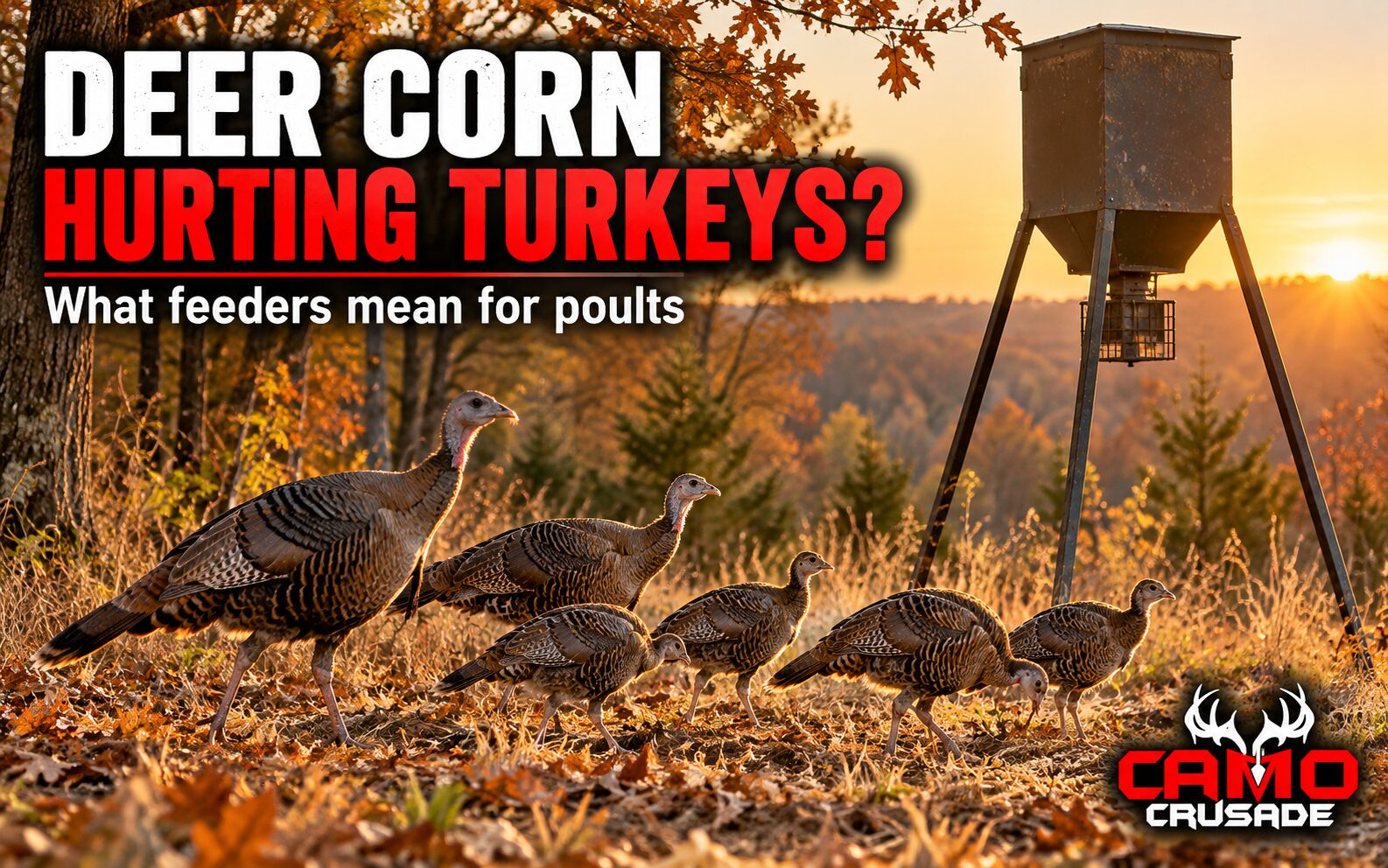
A deer feeder can attract more than deer. If you hunt deer in the fall and turkeys in the spring on the same property, it is worth asking what else that feeding site is doing. Realtree’s report, Is Your Deer Bait Killing Turkeys?, raised concerns about contaminated corn, young-bird nutrition and concentrated nest predators. Those concerns deserve attention, but they are not proof that one feeder caused a local flock to decline.
The useful distinction is between a documented exposure risk and an explanation for a regional population trend. Research supports taking precautions with feed. It does not justify predicting how many turkeys a particular corn pile will cost you next spring.
What the corn studies actually found
Aflatoxins are toxins produced by certain fungi that can contaminate grain. In a 2022 study, Mississippi State University researchers examined feed, feeders and corn piles exposed on the ground. All summer corn piles had detectable aflatoxins after eight days, at concentrations of 483 to 3,475 parts per billion. The authors did not find the same buildup in their hunting-season piles: no aflatoxins were detected in those piles after day one. That seasonal difference matters. It would be inaccurate to say every October pile becomes toxic on a fixed timetable.
A separate 2025 study in Wildlife Society Bulletin tested corn and milo under different moisture, temperature and placement conditions in Oklahoma greenhouse trials. Wet, piled corn produced the highest concentrations, with a maximum of 3,230 parts per billion. The authors recommended keeping grain dry, reducing the time it remains available, avoiding piles and avoiding feeding during warm periods. They explicitly noted that a direct link between aflatoxicosis and recent wild-turkey population declines has not been identified.
Neither study provides a universal number of safe days for corn on your property. Conditions vary, and grain can arrive contaminated. A dry-looking bag or a weatherproof hopper is not a laboratory test or a guarantee.
Nutrition and predators need context
Young poults need protein-rich insects, especially in their first weeks. As they grow, their diet becomes more like an adult turkey’s mixed diet. Corn is not a complete substitute for brood habitat. Realtree quotes University of Georgia biologist Michael Chamberlain warning about broods relying heavily on corn; that concern should not be turned into a claim that every autumn corn visit delays a bird’s development.
Realtree also quotes Auburn biologist William Gulsby about concentrated predators. Feeding sites can draw raccoons and other animals. Experiments with artificial ground nests have found increased predation near feeding sites, but artificial nests are not a direct measurement of survival for every wild-turkey nest. Do not assume a feeder necessarily produces larger predator litters or that moving one will restore turkey numbers.
The older Georgia poult ratios and Alabama nest-success figures in Realtree’s report are not current 2026 population estimates. We have left them out rather than present historical observations as today’s statewide conditions.
Six steps for anyone feeding legally
- Check the location’s current rules. Feeding and baiting restrictions can depend on species, land ownership, season and disease-management area. Legal deer feeding does not make turkey hunting over bait legal.
- Consider stopping supplemental feeding. If you continue where permitted, avoid leaving concentrated corn piles, particularly during warm, wet conditions.
- Buy and store grain carefully. Use a reputable supplier, ask about aflatoxin testing and keep feed dry. Do not treat a low price or a livestock-feed label as proof that a batch is safe for turkeys.
- Prevent accumulation. Maintain the feeder and check for leaks, wet material and uneaten grain underneath. Do not keep adding fresh feed over a damp pile or assume one or two days is always safe.
- Review the site’s placement and use. Avoid concentrating feeding activity in nesting or brood cover. A wildlife biologist can help evaluate the site; relocating it alone does not remove every risk.
- Put effort into habitat. Maintain suitable nesting cover and accessible, insect-rich brood habitat. Seek local guidance before using fire or changing vegetation, and follow all applicable rules for any predator management.
Deer feeding and turkey hunting are separate questions
North Carolina’s current regulations list spring turkey seasons, not a fall season. They also prohibit knowingly taking wild turkeys within 300 yards of a baited place and consider the area baited until 10 days after bait is consumed or removed. Other states have their own restrictions. Check the current rules for the exact property and species before feeding or hunting.
The practical goal is to reduce avoidable exposure and maintain good habitat, without promising that feeder changes alone will reverse a turkey decline.