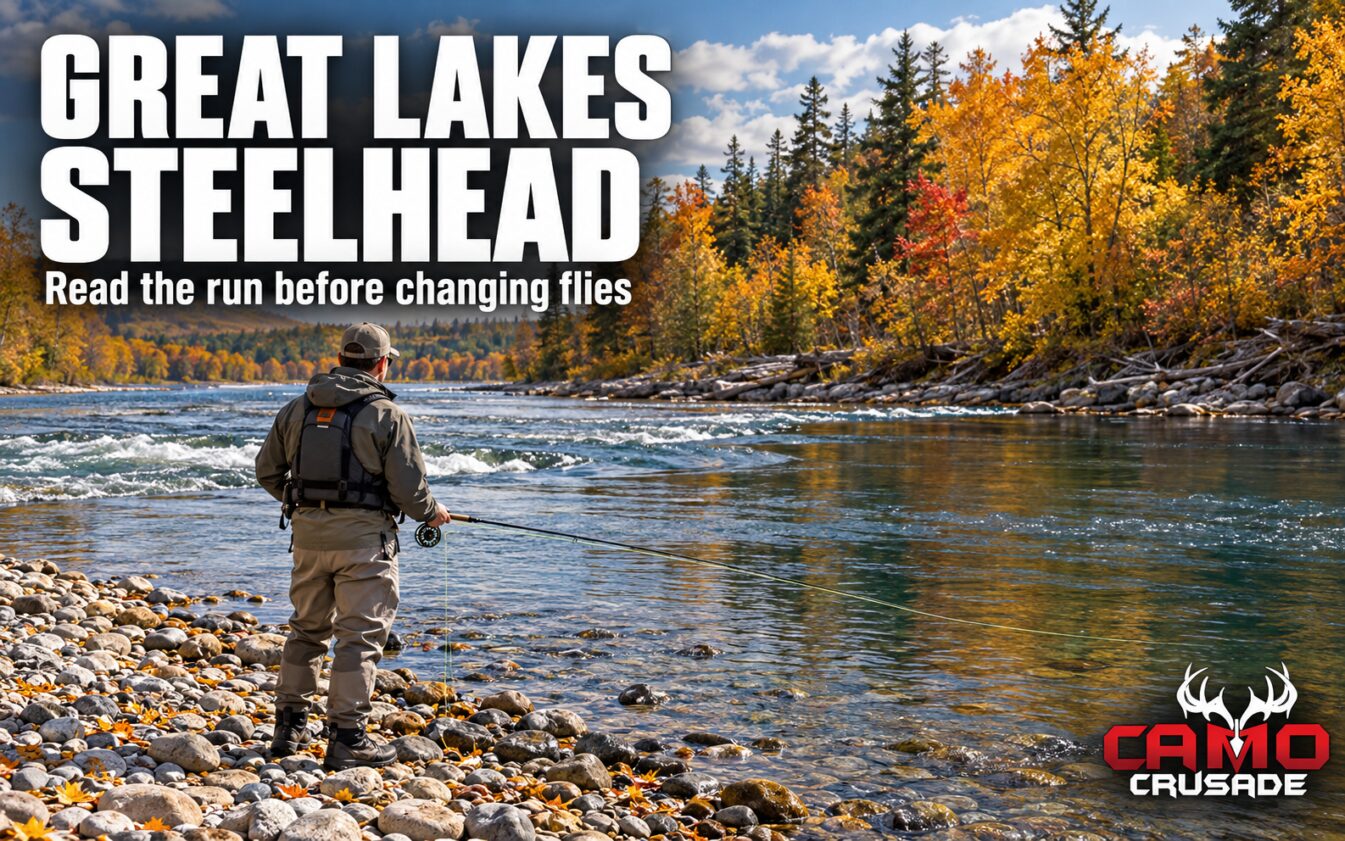
A steelhead river can look empty until one good drift changes your opinion of the whole run. That possibility is part of the draw, but it also makes it easy to blame the fly every time nothing happens.
Outdoor Life’s guide to swinging flies for Great Lakes steelhead emphasizes reading current breaks and adjusting presentation depth. Use that as a method for investigating water. It is more useful than assuming a particular color will solve every difficult afternoon.
Know which fishery you are visiting
Great Lakes steelhead are migratory rainbow trout that spend much of their lives growing in the lakes and enter tributaries to spawn. New York DEC describes both stocking and natural reproduction in its Lake Erie fishery. They are not fish arriving from the ocean, and different strains and tributaries can have different timing.
That distinction matters when planning a trip from the Southeast. Check the actual river’s flow, access and recent agency information. A calendar date copied from another Great Lake does not tell you whether your chosen creek is fishable.
Choose a run you can examine carefully
Look for a manageable section with a current break and a slower holding area. From a secure position, think about where your fly begins sinking and where it actually reaches useful depth. If it only gets down after passing the likely lie, another identical cast may not teach you much.
Change one part of the presentation—angle, depth or pace—and compare the result. Leave enough room for other anglers and ask how they are moving through a shared run. A courteous conversation is quicker than untangling crossed lines.
Skip the aggression-only explanation
Do not assume tributary steelhead strike only from anger. New York DEC explicitly describes active fall feeding. A swung fly can work without requiring that every fish be territorial, and a fish refusing one presentation may simply be a fish refusing one presentation.
Use tackle capable of landing the fish promptly. Keep release fish supported in the water while removing the hook, and avoid spawning fish and redds. Check river-specific tackle, hook, season and access rules before starting. If flows make the crossing questionable, stay on the bank or choose different water; a promising run is not a reason to force a crossing.